

In the realm of engineering simulation, mastering ANSYS Workbench is a transformative journey toward unlocking unparalleled problem-solving capabilities. This article delves into the significance of ANSYS Workbench, exploring how it empowers engineers to deliver innovative and effective solutions across a spectrum of engineering challenges. The Powerhouse of Simulation: ANSYS Workbench ANSYS Workbench stands as a cornerstone in the field of engineering simulation. Its robust capabilities extend across structural, thermal, fluid dynamics, and various multiphysics simulations. Mastery of ANSYS Workbench offers engineers a versatile toolkit to address complex real-world scenarios with accuracy and efficiency. Key Elements of Mastery: Multidisciplinary Simulations: ANSYS Workbench facilitates seamless integration of diverse simulation modules, enabling engineers to explore multidisciplinary interactions within a unified environment. User-Friendly Interface: The intuitive interface of ANSYS Workbench ensures that engineers can navigate through complex simulations with ease, focusing on problem-solving rather than grappling with software intricacies. Parametric Optimization: Harnessing the power of parametric optimization, engineers can systematically explore design spaces, fine-tune parameters, and optimize products for enhanced performance. In-Depth Analysis: ANSYS Workbench provides a platform for in-depth analysis, allowing engineers to gain comprehensive insights into structural integrity, thermal behavior, fluid flow dynamics, and more. Time and Cost Efficiency: By eliminating the need for physical prototypes through virtual testing, ANSYS Workbench contributes to significant time and cost savings in the product development lifecycle. Applications Across Industries: Aerospace: Simulating structural integrity, aerodynamics, and thermal performance of aircraft components. Automotive: Analyzing crashworthiness, optimizing engine performance, and enhancing overall vehicle safety. Energy: Modeling heat transfer in power plants, optimizing turbine design, and simulating fluid dynamics in renewable energy systems. Biomedical: Analyzing the structural behavior of medical devices, simulating blood flow, and optimizing designs for enhanced biocompatibility. The Mastery Journey: Becoming proficient in ANSYS Workbench involves a continuous learning process. Engineers can benefit from online courses, hands-on projects, and collaboration with the vibrant ANSYS user community to continually refine their simulation skills. Conclusion: Empowering engineering solutions goes beyond theoretical knowledge; it requires the mastery of tools like ANSYS Workbench. Engineers who embark on this journey unlock the potential to revolutionize industries, pushing the boundaries of innovation and problem-solving. As technology evolves, mastering ANSYS Workbench remains a strategic investment in shaping the future of engineering excellence.

Finite Element Analysis (FEA) is a numerical method used to solve complex engineering problems by dividing them into smaller, more manageable elements. Software and mathematics play crucial roles in FEA by facilitating the analysis process. Here’s a breakdown of their roles: Software: Preprocessing: FEA software provides tools for creating and defining the geometry, applying boundary conditions, assigning material properties, and generating the finite element mesh. It allows users to set up the analysis parameters and specify the type of analysis to be performed (structural, thermal, fluid, etc.). Mesh Generation: FEA software automatically generates the finite element mesh by subdividing the model into smaller elements. It determines the connectivity between nodes, elements, and their relationships. Postprocessing: After the analysis is complete, FEA software provides postprocessing capabilities to interpret and visualize the results. Users can examine and extract important data, such as stress and deformation distributions, safety factors, mode shapes, and frequencies. This allows for the evaluation of structural performance and the identification of potential design improvements. Parametric Analysis: FEA software often offers parametric capabilities, allowing users to investigate the effects of varying input parameters on the structural response. This enables optimization studies and sensitivity analyses, which can aid in identifying the optimal design or operating conditions for a given structure. User Interface and Workflow: FEA software typically provides a user-friendly interface that allows users to interact with the software efficiently. It offers tools and menus for model setup, analysis control, result visualization, and report generation. The software’s workflow helps streamline the overall analysis process, making it easier for users to set up and execute simulations. Overall, FEA software plays a crucial role in enabling engineers and analysts to perform accurate and efficient structural analysis. It empowers users to predict the behavior of complex systems, optimize designs, and make informed decisions based on the simulation results. Mathematics plays a crucial role in Finite Element Analysis (FEA) by providing the mathematical foundations and techniques necessary for solving complex engineering problems. Here are some key roles of mathematics in FEA: Formulation of Governing Equations: FEA involves formulating the governing equations that describe the behavior of the analyzed structure. These equations are derived from the principles of mechanics, such as equilibrium, compatibility, and constitutive relations. Mathematics provides the tools and techniques to derive and manipulate these equations, allowing for accurate representation of the physical behavior of the structure. Discretization: FEA discretizes the continuous structure into smaller finite elements, each having a simpler geometry and behavior. Mathematics plays a crucial role in defining the shape functions, interpolation techniques, and numerical integration methods used to approximate the behavior of the structure within each finite element. This enables the representation of complex structures using a collection of simpler mathematical models. Solution Methods: FEA involves solving large systems of equations to determine the unknowns, such as displacements, stresses, and strains. Mathematics provides the numerical techniques, such as matrix algebra, numerical integration, and iterative solvers, to efficiently and accurately solve these equations. Advanced mathematical algorithms are used to handle the large-scale systems encountered in FEA, ensuring robust and reliable solutions. Error Estimation and Convergence: Mathematics enables the estimation of errors and the assessment of solution convergence in FEA. Through mathematical analysis, it is possible to determine the accuracy and reliability of the numerical solution, ensuring that it converges to an acceptable level of accuracy. This allows users to assess the quality of the results obtained from the FEA simulations. Parametric Studies and Optimization: Mathematics plays a key role in parametric studies and optimization in FEA. By varying input parameters, mathematical relationships and optimization techniques are employed to analyze the sensitivity of the structure’s response and optimize design parameters for desired performance criteria. This enables engineers to explore and optimize designs more efficiently. Overall, mathematics provides the underlying principles, techniques, and algorithms required for the successful implementation of FEA. It enables the accurate representation, analysis, and optimization of complex structural systems, helping engineers and analysts make informed decisions and improve the design and performance of various engineering applications. In summary, the combination of software and mathematics in FEA allows for accurate modeling and simulation of physical systems. The software provides the necessary tools and interfaces for analysis setup and execution, while mathematics provides the foundation for numerical algorithms and equations to solve the governing equations. CAE encompasses the broader field of utilizing computer software and mathematical models in engineering analysis, with FEA being a specific technique. ARTEM Academy likely offers courses, workshops, or resources to educate individuals on how to effectively utilize the software for analyzing by explaining mathematics of the governing equations involved in various simulation tools for all different types of analysis, enroll for our FEA courses such as Ansys course in India – explore more by visiting our website http://www.artem.co.in.

Shell elements are finite elements used in structural analysis to model thin-walled structures or components, such as plates, shells, and membranes. These elements are designed to capture the behavior of these structures, which have two dominant dimensions (length and width) and a relatively small thickness compared to the other dimensions. Shell elements are used to represent the behavior of structures subjected to bending, membrane forces, and in-plane and out-of-plane loads. They are particularly useful in analyzing structures with large aspect ratios, where the thickness is significantly smaller compared to the other dimensions. These elements have six degrees of freedom per node, including three translations (u, v, w) and three rotations (θx, θy, θz). They can accurately capture both bending and membrane behavior of thin-walled structures. Examples of 6-DOF shell elements include the MITC4 (Mixed Interpolation of Tensorial Components) and DKQ (Discrete Kirchhoff Quadrilateral) elements. Shell elements have several practical applications across various engineering disciplines. Some notable applications include are: Structural Analysis: 2D shell elements are commonly used in structural engineering for the analysis and design of thin-walled structures such as roofs, walls, and shells. They are suitable for modeling structures with complex geometries and capturing the bending and membrane behavior of the shells under different loading conditions. Aerospace and Automotive Industry: 2D shell elements find extensive use in the aerospace and automotive sectors. They are employed to simulate the behavior of aircraft fuselages, car body panels, and other thin-walled structures. These elements allow for efficient analysis of lightweight structures while considering their stiffness, stability, and aerodynamic performance. Shipbuilding and Maritime Engineering: 2D shell elements are utilized in the design and analysis of ship hulls, offshore platforms, and marine structures. They help assess the structural integrity, stability, and hydrodynamic performance of ships and offshore installations subjected to wave loads, wind forces, and other environmental conditions. Building Construction: 2D shell elements are applied in the design and analysis of building facades, curtain walls, and cladding systems. They enable engineers to study the behavior of these thin-walled elements under wind loads, seismic forces, and thermal effects, ensuring their structural integrity and performance. Composite Material Analysis: 2D shell elements are used to model and analyze composite materials, which are widely used in industries such as aerospace, automotive, and sports equipment. They assist in studying the behavior of composite structures, including laminate panels and sandwich structures, taking into account their anisotropic properties, delamination, and failure modes. Packaging Industry: 2D shell elements find applications in the packaging industry, particularly for analyzing the structural behavior of containers, bottles, and packaging materials. They help determine the deformation, stress distribution, and load-bearing capacity of these thin-walled structures under various mechanical and environmental conditions. The practical applications mentioned above emphasize the flexibility of 2D shell elements in accurately representing the behavior of thin-walled structures. This capability allows engineers to effectively design and enhance the performance of such structures in various industries and applications. Students attending the course in Artem Academy, particularly focused on using HyperMesh software, will gain comprehensive knowledge and skills in utilizing these 2D elements for optimal design outcomes.

Linear static analysis refers to a computational technique used in engineering and structural analysis to predict the response of a structure under applied loads or forces. It assumes linear relationships between applied loads and resulting displacements, as well as linear elastic material behavior within the structure. In linear static analysis, the governing equations of linear elasticity, such as the equilibrium equations and the stress-strain relationship described by Hooke’s law, are solved to determine the deformations, displacements, and internal forces within the structure. The analysis assumes small deformations, where the linear strain-displacement relationship holds, and it assumes that the material properties of the structure are homogeneous and isotropic. The analysis involves dividing the structure into smaller elements, typically finite elements, and solving the equilibrium equations for each element and the connections between them. The resulting system of linear equations is then solved using numerical techniques such as the finite element method (FEM) or other matrix-based methods to obtain the displacements and internal forces. Where K = Stiffness matrix U = Displacement Matrix F = Force Matrix Linear static analysis provides insights into the stresses, deformations, and displacement patterns within a structure, allowing engineers to evaluate its strength, stability, and safety. It is widely used in various fields, including civil engineering, mechanical engineering, aerospace engineering, and more, for designing and analyzing structures such as buildings, bridges, mechanical components, and assemblies. Importance of Linear Static Analysis Linear static analysis is a fundamental and widely used technique in engineering and structural analysis. It serves several important purposes and provides valuable insights into the behavior of structures. Here are some reasons highlighting the need and importance of linear static analysis: Predicting Structural Response: Linear static analysis helps predict the response of structures under various loading conditions. By analyzing the stresses, displacements, and deformations, engineers can assess the structural integrity and ensure that the design meets the desired criteria. It allows for evaluating the strength, stability, and safety of a structure. Design Validation and Optimization: Linear static analysis aids in the design validation process. Engineers can verify the performance of a structure by applying expected loads and studying the resulting behavior. It enables the identification of potential design flaws, weak points, and areas of excessive stress or deformation. This information can guide design optimization and modification to enhance the performance and efficiency of the structure. Load Distribution: Linear static analysis helps determine how loads are distributed within a structure. By studying the internal forces and stresses, engineers can understand how different components and members bear the load. This information is crucial for structural engineers to ensure that the load is properly distributed, and no individual component is subjected to excessive stress or overload. Material Selection: Linear static analysis facilitates material selection for a structure by evaluating stress levels and deformations. Engineers can assess the suitability of different materials based on their stiffness, strength, and other mechanical properties within the linear elastic range. ANSYS Workbench, a powerful engineering simulation software, can be used to analyze the mechanical behavior of structures. Learning ANSYS Workbench with Artem Academy can enhance engineers’ proficiency in utilizing this software for linear static analysis and other advanced engineering simulations. Artem Academy offers specialized courses that teach engineers how to effectively model and analyze structures, simulate various materials, and evaluate stress levels and deformations. By combining theoretical knowledge of material properties with practical application using ANSYS Workbench, engineers can confidently select materials that meet the specific requirements of a structure and can withstand anticipated loads and deformations within the linear elastic range. Support System Design: Linear static analysis aids in the design of support systems, such as beams, columns, and connections. By analyzing the internal forces and deformations, engineers can determine the required sizes, shapes, and configurations of support elements. This helps ensure the stability, rigidity, and proper load transfer within the structure. Cost and Time Savings: Linear static analysis allows engineers to assess different design alternatives quickly and cost-effectively. By simulating the behavior of a structure in a virtual environment, engineers can identify potential issues and make necessary modifications before physical prototypes or full-scale manufacturing. This iterative process saves time, reduces material waste, and minimizes the cost of physical testing and revisions. Overall, linear static analysis is a vital tool for engineers to understand and optimize the structural behavior of a wide range of systems. It provides valuable insights for design, validation, optimization, and ensuring the structural integrity and safety of various engineering projects.

In Finite Element Analysis (FEA), there are various types of elements used to represent different physical phenomena and geometries. Here are some commonly used element types and their practical applications: 1D Elements: Beam Element: Represents a linear structural member with a length but negligible thickness in comparison, allowing for the analysis of bending, axial, and shear behavior. It is often used for analyzing beam structures, such as bridges or building frames. The beam element is typically represented as a line segment. Truss Element: Represents a one-dimensional member with no bending stiffness, making them useful for analyzing structures primarily subjected to axial forces. It is commonly used for analyzing truss structures or skeletal frameworks. The truss element is represented as a line segment with nodes at each end. 2D Elements: Triangle Element: Represents a two-dimensional element with three nodes forming a triangular shape. It is frequently used in plane stress or plane strain analysis. Triangle elements are effective for modeling irregular geometries and are particularly useful for analyzing thin structures subject to in-plane loads. The triangle element is defined by three points in a two-dimensional space. Quadrilateral Element: Represents a two-dimensional element with four nodes forming a quadrilateral shape. It is versatile and widely used in analyzing structures with complex geometries, including planar and curved surfaces. Quadrilateral elements provide flexibility in capturing various load conditions and are commonly used in general-purpose structural analysis. The quadrilateral element is defined by four points in a two-dimensional space. 2D elements types: Plane stress – Stress in z direction (thickness) is 0. Plane strain – Strain in z direction (thickness) is 0 Plane stress with thickness – Stress in z direction (thickness) is ≠ 0 Axisymmetric – Stress in z direction (thickness) is 0 (in rotational direction) Shell Elements: Used to model thin structures, such as plates and shells. Shell elements have both in-plane and out-of-plane capabilities, allowing for the analysis of bending, membrane, and shear behavior. They are commonly employed in the analysis of structures like aerospace panels, automotive body components, and pressure vessels. Used for modeling three-dimensional objects with volumetric properties. Solid elements provide accurate representation of internal stresses and deformations in solid materials, making them suitable for analyzing components like machine parts, mechanical assemblies, and structural components. 3D Elements: Tetrahedron Element: Represents a three-dimensional element with four nodes forming a pyramid-like shape. It is often used for modeling irregular geometries and solid structures. The tetrahedron element is defined by ten points in a three-dimensional space. Tetrahedron elements are commonly used in applications such as fluid flow analysis, stress analysis of complex parts, and simulating deformation in biological tissues. Hexahedron Element: Represents a three-dimensional element with eight nodes forming a cube-like shape. It is commonly used for modeling regular geometries and solid structures including blocks, beams, and plates. Hexahedron elements offer greater accuracy and efficiency for certain types of analyses, such as thermal analysis or static stress analysis of solid objects. Pyramid Element: Represents a three-dimensional element with twenty nodes forming a cube/tet/pyramid like shape. It is often used for modeling irregular geometries and solid structures. It is of second order element with mid-side nodes. Pyramid elements are widely used for capturing critical locations at regular geometry and to connect hexahedron and tetrahedron element. The choice of element type in FEA depends on various factors such as the specific application, geometry, and desired level of accuracy. FEA software packages like ANSYS offer a range of element options to accommodate different engineering problems and ensure efficient and accurate analysis of structures and systems. If you are interested in enrolling in an ANSYS course in India, I recommend searching online for educational institutions which was curated by IIT and experienced faculty in Hyderabad i.e., from Artem Academy. You can explore various options, compare their course content, duration, and instructor expertise to find the one that best suits your needs.
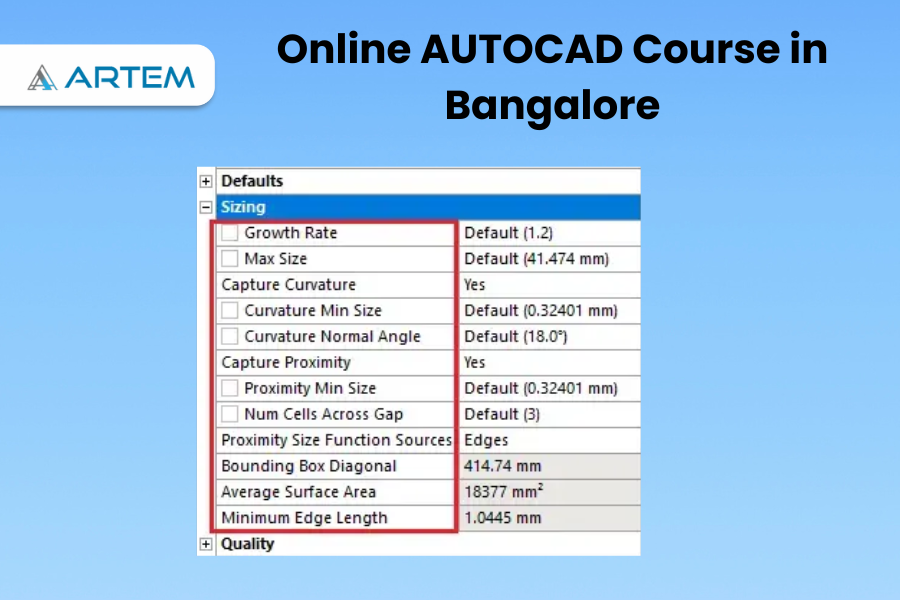
Online AUTOCAD Course in India AutoCAD is a software that has revolutionized the field of design. It is one of the leading software in 3D designing, 2D drafting and detailing projects in a number of industries. What is AutoCAD? AutoCAD is a computer-aided design (CAD) software application used for creating 2D and 3D designs. AutoCAD was developed by Autodesk in 1982 and has become one of the most widely used CAD programs. The software can be used for a variety of purposes, such as creating electrical schematics, designing buildings, or creating mechanical parts. AutoCAD is a powerful tool that can help you create precise 2D and 3D designs. The software is easy to use and has a wide range of features that make it suitable for a variety of design tasks. If you’re looking to learn AutoCAD, our online course is the perfect way to get started. Why Choose an Online Course? There are many reasons to choose an online AUTOCAD course in India. One reason is that it is more convenient than a traditional classroom setting. You can access the course material at any time and from any location with an internet connection. Another reason to choose an online course is that you can usually complete the course at your own pace. This means that you can take as much or as little time as you need to complete the assignments and learn the material. This can be especially helpful if you have a busy work or home life. Lastly, many online courses offer a variety of interactive features that can make learning more fun and engaging. For example, some courses include video lectures, while others offer forums where you can discuss course material with other students. Online AUTOCAD Course in India: Benefits of Our AutoCAD Courses Learn from Experienced Professionals: All of our AutoCAD courses are taught by experienced professionals who have years of experience using the software. This means that you’ll be able to learn from their wealth of knowledge and get the most out of your training. Get Hands-on Experience: One of the best ways to learn AutoCAD is by getting hands-on experience with the software. With our courses, you’ll be able to work on real-world projects and gain valuable practical experience. Affordable and Flexible: Our courses are very affordable, especially when compared to traditional classroom-based training. They are also flexible, so you can study at your own pace and in your own time. Industry Recognized Certification: Upon completion of our courses, you’ll receive an industry recognized certification which will help you to advance your career. What You Will Be Learning in the Course? In this online AUTOCAD course in India, you will be learning about the different features and functions of the software. You will also be learning how to create 2D and 3D designs using the software. The course will also teach you how to use the software to create drawings for engineering, architectural, and other purposes. Best Place to Take Your AutoCAD Course! There are a few things to consider when choosing the best place to take your AutoCAD course. Depending on your level of experience and knowledge, you may want to consider a course that is offered by a certified AutoCAD instructor. These instructors typically have years of experience and can offer you one-on-one attention, as well as a wealth of information. Additionally, many colleges and universities now offer AutoCAD courses online. These courses are often more affordable than those offered in person, and they provide you with the flexibility to complete the course at your own pace. If you’re considering an online course, be sure to research the quality of the course and the reputation of the provider before enrolling. Finally, if you know someone who has recently taken an AutoCAD course, ask for their recommendation. They may be able to point you in the direction of a great instructor or tell you about an online course that they found especially helpful. What are the eligibility of AutoCAD course? Anyone can join the course from diploma, graduate & post-graduation. There is no pre-requisite for the AutoCAD course. In order to be eligible for the AutoCAD course, you must have a basic understanding of computers and their operations. This course is not meant for beginners. You should also have a basic knowledge of drafting and engineering principles. If you have these skills, then you will be able to get the most out of the course.

In the dynamic world of engineering, the pursuit of precision is unceasing. Whether it’s designing a safer bridge, optimizing an aerospace component, or developing cutting-edge consumer products, engineers rely on advanced tools to ensure the utmost accuracy in their designs. Among these tools, Ansys Workbench Analysis stands as a beacon of precision, offering a comprehensive suite of simulation capabilities that enable engineers to fine-tune and validate their designs with unmatched accuracy. Understanding Ansys Workbench Analysis Ansys Workbench is a powerful simulation platform that brings together a wide array of simulation tools under one user-friendly interface. It covers diverse domains such as structural, thermal, fluid dynamics, electromagnetic, and more. This all-encompassing approach allows engineers to perform multiphysics simulations, gaining insights into how different physical phenomena interact and affect their designs. Precision in Structural Analysis One of the fundamental areas where Ansys Workbench excels is structural analysis. Engineers can simulate the behavior of materials and structures under various loads, assessing factors like stress, deformation, and vibration. This precision is invaluable in ensuring the structural integrity of critical components, whether it’s the frame of a vehicle or a high-rise building. Thermal Analysis for Precision in Heat Management In an era where electronics play a pivotal role in our lives, precision in thermal management is paramount. Ansys Workbench allows engineers to simulate how heat dissipates through components and optimize cooling systems for maximum efficiency. The result is devices that perform better and have a longer lifespan. Fluid Dynamics for Efficiency and Precision In the world of fluid dynamics, precision is essential for optimizing anything from aircraft wings to HVAC systems. Ansys Workbench Analysis enables engineers to model fluid flow, heat transfer, and pressure distribution with great accuracy. This precision leads to more efficient designs and significant energy savings. Electromagnetic Analysis for Electronics The electronics industry requires a high level of precision in the design of circuits and antennas. Ansys Workbench offers electromagnetic simulation tools that help engineers fine-tune these designs to ensure optimal signal transmission, minimal interference, and compliance with industry standards. Multiphysics Simulations: Precision Beyond Single Domains What sets Ansys Workbench Analysis apart is its ability to handle multiphysics simulations. Engineers can study how various physical phenomena interact, such as how heat affects structural integrity or how fluid flow impacts electromagnetic performance. This holistic approach allows for a deeper level of precision and accuracy in engineering designs. Real-World Applications Ansys Workbench’s precision is not just theoretical; it has real-world applications. It’s used in aerospace to optimize aircraft and spacecraft design, in automotive engineering to enhance vehicle safety and fuel efficiency, and in medical device development to ensure precision and safety in healthcare technology.

Linear static analysis makes several assumptions to simplify the analysis of structures. These assumptions are necessary to apply the principles of linear elasticity and simplify the governing equations. Here are some common assumptions made in linear static analysis: Linear Elastic Material Behavior: Linear static analysis assumes that the material used in the structure exhibits linear elastic behavior. This means that the material obeys Hooke’s law, where the stress is directly proportional to the strain within the elastic limit. Nonlinear material behavior such as plasticity, creep, or large deformations is not considered in linear static analysis. Small Deformations: Linear static analysis assumes that the deformations in the structure are small. This assumption allows the use of the linear strain-displacement relationship, where the strain is directly proportional to the displacement. Large displacements that cause significant geometric changes and nonlinear effects are not considered in linear static analysis. Linear Relationship between Loads and Displacements: Linear static analysis assumes that the applied loads and resulting displacements have a linear relationship. This assumption implies that the structure’s response is directly proportional to the applied loads. It assumes that the superposition principle holds, meaning the response to multiple loads is the sum of the individual responses to each load. Static Equilibrium: Linear static analysis assumes that the structure is in a state of static equilibrium. This means that the applied loads and internal forces within the structure are balanced, resulting in zero net force and moment. Dynamic effects, such as inertial forces, are not considered in linear static analysis. Homogeneous and Isotropic Material: Linear static analysis assumes that the material properties of the structure are homogeneous (uniform throughout) and isotropic (properties do not vary with direction). This simplifies the analysis by assuming that the material behaves the same in all directions. Small Strain Theory: Linear static analysis employs the small strain theory, which assumes that the strains in the structure are small enough that the change in shape can be approximated by linear relationships. By making this assumption, the strain-displacement equations become simplified, facilitating the analysis process. At Artem Academy, we offer a comprehensive ANSYS course that covers the principles and applications of finite element analysis. Our course delves into various aspects of structural analysis, including linear static analysis. For more details, advanced analysis techniques, such as nonlinear analysis, may be required to accurately model the behavior of the structure .By enrolling in our ANSYS course online, students will gain a solid understanding of how to effectively utilize the ANSYS software to perform linear static analysis and other advanced simulations. Throughout the course, we explore the limitations of this theory and introduce more advanced analysis methods for scenarios where large strains or nonlinear behavior are involved. By providing a well-rounded education in structural analysis, our ANSYS course equips students with the necessary knowledge and skills to tackle complex engineering challenges. Whether you are a beginner seeking an introduction to ANSYS or an experienced professional looking to enhance your simulation capabilities, Artem Academy’s ANSYS course is designed to meet your needs. Join us today and take your engineering analysis skills to new heights.

Isotropic material properties refer to the characteristics of a material that are independent of direction. In other words, their mechanical and physical characteristics, such as elasticity, thermal expansion, and conductivity, are the same regardless of the direction in which they are measured. Isotropic materials exhibit the same response to stress, strain, and other external factors, making their behavior predictable and uniform in all orientations. For example, consider a solid cube made of an isotropic material. When subjected to mechanical loading, the cube will deform uniformly in all directions, and the resulting stress and strain will be the same regardless of the orientation of the applied forces. That means, the response to applied forces or stimuli is the same regardless of the direction in which they are applied. For example, if a force is applied to an isotropic material along the x-axis, the resulting deformation or strain will be the same as if the force were applied along the y-axis or z-axis. Similarly, the thermal expansion and conductivity will be the same in all directions, and the material will exhibit the same electrical and magnetic properties in any direction. Homogeneous materials have uniform properties throughout their structure. This means that their composition and characteristics, such as density, composition, and mechanical properties, are consistent and identical in all regions. In other words, there are no variations or gradients in their material properties within the material itself. In summary, isotropic materials have consistent properties in all directions, while homogeneous materials have uniform properties throughout their structure without any variations or gradients. Here the details of material properties are mentioned below: Elastic Modulus: The elastic modulus, also known as Young’s modulus, is a measure of a material’s stiffness. In an isotropic material, the elastic modulus is the same in all directions, meaning it has the same resistance to deformation in any direction. Thermal Conductivity: Thermal conductivity is a property that describes a material’s ability to conduct heat. In an isotropic material, the thermal conductivity is uniform in all directions, meaning heat transfers at the same rate regardless of the direction of heat flow. Electrical Conductivity: Electrical conductivity refers to a material’s ability to conduct electric current. In an isotropic material, the electrical conductivity is the same in all directions, allowing for uniform electrical conduction throughout the material. Magnetic Permeability: Magnetic permeability is a measure of how easily a material can be magnetized in the presence of a magnetic field. In an isotropic material, the magnetic permeability is constant in all directions, indicating the same response to magnetic fields regardless of orientation. Density: Density represents the mass per unit volume of a material. In an isotropic material, the density remains the same regardless of the direction in which it is measured. These are just a few examples of isotropic material properties. It’s important to note that these properties are idealized assumptions and may not hold true for all materials in reality. Different materials can have varying degrees of isotropy or anisotropy, depending on their composition, crystal structure, and manufacturing processes. Isotropic material properties are represented by 2 independent variables i.e., Young’s modulus and Poisson’s ratio and is represented in equation as mentioned below form: Isotropic materials are often used as simplifying assumptions in engineering and scientific analyses because they are easier to work with mathematically and provide a good approximation for many practical applications. Common examples of isotropic materials include many metals (e.g., aluminum, steel), certain polymers, and some ceramic materials. Here are some common examples of isotropic materials: Glass: Most types of glass, such as window glass or soda-lime glass, are considered isotropic. They exhibit the same physical properties, such as optical transparency and mechanical strength, in all directions. Aluminum: Aluminum and its alloys, including commonly used ones like 6061 and 7075, are generally considered isotropic. They have consistent mechanical properties, such as stiffness and strength, in all directions. Polycarbonate: Polycarbonate is a transparent thermoplastic material widely used in applications such as safety glasses and bulletproof windows. It is isotropic and exhibits consistent properties throughout. Rubber: Certain rubber materials, such as natural rubber or synthetic elastomers like neoprene, can be considered isotropic. They possess similar properties in all directions, including elasticity and resilience. Polyethylene: Polyethylene, a widely used thermoplastic material, can exhibit isotropic behavior depending on its manufacturing process and grade. It is commonly used in packaging, pipes, and other applications. Acrylic: Acrylic, also known as PMMA (polymethyl methacrylate), is a transparent thermoplastic material that is often used as a substitute for glass. It is typically isotropic and has consistent properties in all directions. Isotropic materials are often used as simplifying assumptions in engineering and scientific analyses because they allow for easier calculations and predictions. Some examples of isotropic materials include many metals, certain polymers, and some ceramic materials. It’s important to note that while these materials are generally considered isotropic, specific manufacturing processes, additives, or material modifications can introduce some level of anisotropy in certain cases. Additionally, it’s always advisable to consult material specifications and conduct testing to confirm the isotropic behavior of a specific material.

Linear static analysis has numerous practical applications across various engineering disciplines. Here are some common practical examples mentioned: Structural Analysis: Linear static analysis is widely employed in structural engineering to evaluate the behavior of various structures, including buildings, bridges, towers, and other architectural elements. It helps determine the stresses, deformations, and displacement patterns under different loading conditions. Engineers can evaluate the strength and stability of structural components, optimize designs, and ensure compliance with safety regulations. Mechanical Component Design: This analysis is employed in the design of mechanical components such as machine parts, mechanisms, and industrial equipment. It helps evaluate the structural integrity and performance of components under applied loads. This analysis aids in optimizing component designs, identifying areas of excessive stress or deformation, and ensuring the functionality and reliability of the product. Automotive Industry: Linear static analysis plays a crucial role in automotive engineering. It helps assess the structural integrity and performance of vehicle components, such as chassis, frames, suspension systems, and body structures. This analysis aids in optimizing designs for weight reduction, improving vehicle safety, and ensuring durability under various operating conditions. Aerospace and Aircraft Design: In aerospace engineering, linear static analysis is used to analyze and optimize the structural behavior of aircraft components, such as wings, fuselages, and landing gear. It aids in assessing the structural integrity, load distribution, and stiffness of these components. Linear static analysis is also employed to study the interactions between different structural elements and evaluate their overall performance. Civil Engineering and Infrastructure: Linear static analysis is applied in civil engineering to analyze the behavior of structures like dams, tunnels, pipelines, and offshore structures. It helps evaluate the stability, load-carrying capacity, and safety of these structures under various loading conditions. Linear static analysis also aids in designing foundations, retaining walls, and other structural elements to ensure their stability and resistance to failure. Consumer Products and Industrial Machinery: Linear static analysis is an essential technique utilized in the design and optimization of consumer products like furniture, appliances, and electronic devices. It allows engineers to assess and ensure the structural integrity, load-bearing capacity, and overall safety of these products. Moreover, this type of analysis finds application in the analysis and design of industrial machinery and equipment, guaranteeing their structural soundness and reliability. Professionals in engineering fields, including those pursuing an ANSYS course in India, often rely on linear static analysis to understand the behavior of structures subjected to static loads. It enables them to optimize designs, evaluate performance, and ensure the safety and functionality of various systems and structures. Linear static analysis is just one type of analysis among many available, and it serves as a fundamental tool for engineers in their pursuit of design excellence and problem-solving.