
In modal analysis, mode shapes and nodal diameters are essential concepts that provide valuable insights into the dynamic behavior of structures. Let’s delve into each term and understand their significance, along with the corresponding formulas. Mode Shapes: Definition: Mode shapes represent the spatial distribution of displacements within a structure at a specific natural frequency. They illustrate how different parts of the structure move relative to each other during vibration. Formula: For a structure with �n degrees of freedom, the mode shape is represented by a vector �U, where each element ��Ui denotes the displacement at the �i-th degree of freedom. The mode shape is obtained by solving the eigenvalue problem: ��=�2��KU=ω2MU Here, �K is the stiffness matrix, �M is the mass matrix, �ω is the circular frequency (related to the natural frequency by �=2��ω=2πf), �U is the mode shape vector. In practical terms, once the eigenvalues and eigenvectors are obtained, the mode shapes are extracted from the eigenvectors. Nodal Diameters: Definition: Nodal diameters are regions within a mode shape where the displacement is zero. These nodal diameters correspond to points of minimal or no movement during vibration. Formula: The nodal diameters can be understood through the mode shape vector �U. The positions where the elements of �U are zero represent nodal points or lines. For a given mode shape, the nodal diameters are essentially the areas or lines of the structure where no motion occurs. For a 1D structure (e.g., a beam), a nodal diameter might be a point where the displacement is zero. For a 2D structure (e.g., a plate), nodal diameters could be lines or curves where the displacement is zero. In 3D structures, nodal volumes may exist. Significance: 1.Mode Shapes: Understanding mode shapes is crucial for engineers as they provide a visual representation of how a structure deforms during vibration. This insight is essential for optimizing designs, identifying potential weaknesses, and ensuring that the structure can withstand dynamic loads without encountering resonance issues. 2.Nodal Diameters: Identifying nodal diameters helps engineers pinpoint regions in a structure where minimal or no movement occurs during vibration. This information is valuable for design optimization, allowing engineers to reinforce or modify specific areas to enhance structural performance. In summary, mode shapes and nodal diameters play pivotal roles in modal analysis, offering engineers a deeper understanding of the dynamic response of structures and aiding in the design and optimization processes.

Saint-Venant’s Principle, named after the French engineer Adhémar Jean Claude Barré de Saint-Venant, is a concept in structural mechanics that provides guidance on how the distribution of stress becomes more uniform at a sufficient distance from a concentrated load or point of load application. The principle is particularly useful when analyzing the behavior of structures under localized loads. Saint-Venant’s Principle: Statement: “The stresses and displacements caused by the application of a concentrated load to a structural member become nearly constant at a sufficiently large distance away from the point of load application.” In simpler terms, as you move away from the point where a load is applied, the local effects of the load become less significant, and the behavior of the structure tends to become more uniform. Formula for Point Load Application: When applying a point load to a structural member, such as a beam, the distribution of stress and deformation can be determined using the equations derived from Saint-Venant’s Principle. For a simply supported beam subjected to a concentrated load at a point, the bending moment (M) and shear force (V) formulas at a distance x from the point of load application are given by: 1.Bending Moment (M): M(x)=P⋅(L−x) where: P is the point load applied, L is the span length of the beam, x is the distance from the point of load application. 2.Shear Force (V): V(x)=P The shear force remains constant along the length of the beam and is equal to the applied point load. Assumptions and Considerations: 1.Linear Elastic Material: Saint-Venant’s Principle is applicable to linear elastic materials, where the stress-strain relationship is linear. 2.Sufficient Distance: The principle becomes more accurate as you move a sufficient distance away from the point of load application. This distance is generally considered to be a few times the depth of the beam. 3.Uniformaly Loaded Section: Saint-Venant’s Principle is more accurate for predicting the behavior of a section that is uniformly loaded. It is less accurate for predicting local effects near the point of load application. 4.Symmetrical Loading: For symmetrical loading conditions, Saint-Venant’s Principle tends to be more applicable. Application in Engineering: Saint-Venant’s Principle is widely used in engineering practice, particularly in structural analysis and design. It allows engineers to simplify complex loadings and assess the behavior of structures under more manageable conditions, especially when analyzing the effects of localized loads on beams and other structural elements. It’s important to note that while Saint-Venant’s Principle is a valuable tool, there are situations where its applicability may be limited, such as in regions close to the point of load application or in cases involving significant torsional effects. Engineers should be mindful of these limitations and use the principle judiciously in their analyses.

Introduction: In the realm of structural engineering, the quest for understanding the dynamic behavior of systems has led to the development of sophisticated analysis techniques. One such powerful method is Free-Free Modal Analysis, a process that goes beyond conventional modal analysis by considering structures that are unrestrained at their boundaries. In this blog, we’ll explore the formulation behind Free-Free Modal Analysis, unlocking the secrets to finding natural frequencies and mode shapes. Understanding the Basics: Before delving into the formulation, let’s grasp the fundamental principles governing Free-Free Modal Analysis: 1.Unrestrained Boundaries: Unlike traditional modal analysis, Free-Free Modal Analysis assumes that the structure is not fixed or constrained at its boundaries. This is a crucial departure from other modal analysis methods, as it allows for a more accurate representation of the dynamic behavior of the system. 2.Natural Frequencies: The primary objective of this analysis is to determine the natural frequencies of the structure. These frequencies represent the inherent vibrational modes of the system and are critical for understanding how it responds to dynamic loads. 3.Mode Shapes: Mode shapes describe the spatial distribution of deformations within the structure during vibration. Identifying mode shapes is essential for gaining insights into the dynamic response and potential weaknesses of the system. Formulation of Free-Free Modal Analysis: The formulation for Free-Free Modal Analysis involves solving the equations of motion for the structure. The basic equation of motion for a single-degree-of-freedom system can be expressed as: Mu¨+Cu˙+Ku=F where: M is the mass matrix, C is the damping matrix, K is the stiffness matrix, u is the displacement vector, u¨ is the acceleration vector, u˙ is the velocity vector, and F is the force vector. For a structure with multiple degrees of freedom, the equation of motion becomes a set of coupled second-order differential equations, typically represented in matrix form as: MU¨+CU˙+KU=F where U is the vector of displacements for all degrees of freedom. To find the natural frequencies and mode shapes, one needs to solve the eigenvalue problem: KU=ω2MU Here, ω represents the circular frequency, and U is the eigenvector associated with each natural frequency. Once the natural frequencies (ω) are obtained, the corresponding mode shapes can be extracted from the eigenvectors U. These mode shapes depict the spatial distribution of deformations during vibration. Applications and Benefits: 1.Aerospace Industry: Free-Free Modal Analysis aids in optimizing the design of aircraft and spacecraft, ensuring that the structures can withstand dynamic loads encountered during flight. 2.Automotive Engineering: In the automotive sector, this analysis technique is employed to enhance vehicle safety, comfort, and overall performance by identifying and addressing potential vibration issues. 3.Civil Engineering: Free-Free Modal Analysis plays a crucial role in designing resilient structures such as bridges and buildings, helping engineers understand and mitigate the impact of dynamic forces like wind and earthquakes. Conclusion: Free-Free Modal Analysis, with its sophisticated formulation, stands as a cornerstone in unraveling the complexities of structural dynamics. Armed with the ability to determine natural frequencies and mode shapes, engineers can optimize designs and ensure the robustness of structures across various industries. As technology advances, the integration of such analytical tools continues to shape the future of structural engineering, offering unprecedented insights for safer and more efficient designs.

Introduction: Structural analysis is a critical aspect of engineering and design, providing invaluable insights into the dynamic behavior of various systems. One powerful technique used in this domain is Free-Free Modal Analysis. In this blog, we’ll delve into the intricacies of this methodology, understanding its principles, applications, and how it contributes to optimizing the design and performance of structures. Understanding Free-Free Modal Analysis: Modal analysis is a technique employed to study the dynamic characteristics of structures by identifying their natural frequencies and mode shapes. Free-Free Modal Analysis, in particular, focuses on systems that are not restrained or fixed at their boundaries. This method is especially relevant in scenarios where the structural elements are not rigidly connected to external supports. Principles of Free-Free Modal Analysis: 1.Natural Frequencies: The primary goal of Free-Free Modal Analysis is to determine the natural frequencies of a structure. These frequencies represent the inherent vibration modes of the system, shedding light on how it responds to dynamic forces. 2.Mode Shapes: Mode shapes describe the spatial distribution of displacements and provide insight into how a structure deforms during vibration. Identifying mode shapes is crucial for understanding the dynamic behavior of the system. 3.Boundary Conditions: The ‘free-free’ aspect of this analysis signifies that the structure is unrestrained at its boundaries. This condition allows for a more accurate representation of the true dynamic response of the structure, as it eliminates the influence of external constraints. Applications of Free-Free Modal Analysis: 1.Aerospace Engineering: In the aerospace industry, Free-Free Modal Analysis is pivotal for understanding the vibration characteristics of aircraft and spacecraft structures. Identifying and mitigating potential resonances is crucial to ensuring the safety and longevity of these vehicles. 2.Automotive Industry: Car manufacturers employ Free-Free Modal Analysis to assess the structural integrity and performance of vehicle components. This analysis aids in optimizing designs for enhanced safety, comfort, and fuel efficiency. 3.Civil Engineering: Free-Free Modal Analysis is applicable in civil engineering to study the dynamic behavior of bridges, buildings, and other structures subjected to environmental loads such as wind and earthquakes. This knowledge helps engineers design structures that can withstand dynamic forces. 4.Mechanical Systems: In the realm of mechanical engineering, this analysis technique is used to study the vibrations of machinery and mechanical components. It assists in identifying potential sources of failure and optimizing the design for reliability. Benefits of Free-Free Modal Analysis: 1.Accurate Representation: By considering the free-free boundary conditions, this analysis method provides a more realistic representation of how a structure behaves in real-world conditions. 2.Optimization of Designs: Understanding the natural frequencies and mode shapes allows engineers to optimize designs, ensuring that structures can withstand dynamic loads without experiencing resonance or other detrimental effects. 3.Early Detection of Issues: Identifying potential issues related to vibration and dynamic response during the design phase enables engineers to address and rectify problems before the construction or manufacturing process begins. Conclusion: Free-Free Modal Analysis stands as a powerful tool in the engineer’s toolkit, offering insights into the dynamic behavior of structures across various industries. From aerospace to civil engineering, the application of this methodology contributes to safer, more efficient, and resilient designs. As technology continues to advance, the integration of modal analysis techniques like Free-Free Modal Analysis will play a pivotal role in shaping the future of structural engineering.

Supports are arguably one of the most important aspects of a structure, as it specifies how the forces within the structure are transferred to the ground.
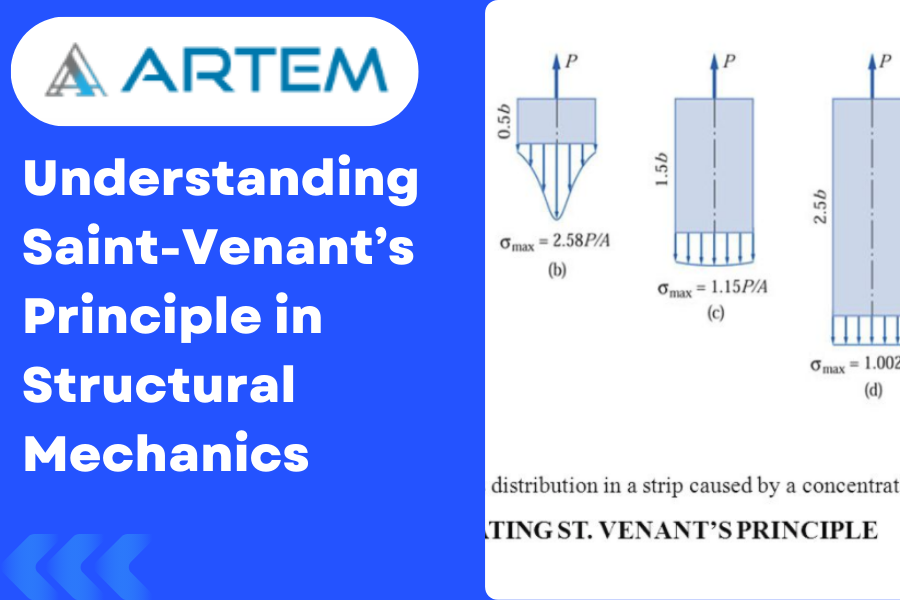
Saint-Venant’s Principle, named after the French engineer Adhémar Jean Claude Barré de Saint-Venant, is a concept in structural mechanics that provides guidance on how the distribution of stress becomes more uniform at a sufficient distance from a concentrated load or point of load application. The principle is particularly useful when analyzing the behavior of structures under localized loads. Saint-Venant’s Principle: Statement: “The stresses and displacements caused by the application of a concentrated load to a structural member become nearly constant at a sufficiently large distance away from the point of load application.” In simpler terms, as you move away from the point where a load is applied, the local effects of the load become less significant, and the behavior of the structure tends to become more uniform. Formula for Point Load Application: When applying a point load to a structural member, such as a beam, the distribution of stress and deformation can be determined using the equations derived from Saint-Venant’s Principle. For a simply supported beam subjected to a concentrated load at a point, the bending moment (M) and shear force (V) formulas at a distance x from the point of load application are given by: Bending Moment (M): $$ M(x)=P⋅(L-x)\;$$ where: P is the point load applied, L is the span length of the beam, x is the distance from the point of load application. Shear Force (V): $$V(x)=P$$The shear force remains constant along the length of the beam and is equal to the applied point load. Assumptions & Considerations: 1. Linear Elastic Material: Saint-Venant’s Principle is applicable to linear elastic materials, where the stress-strain relationship is linear. 2. Sufficient Distance: The principle becomes more accurate as you move a sufficient distance away from the point of load application. This distance is generally considered to be a few times the depth of the beam. 3. Uniformly Loaded Section: Saint-Venant’s Principle is more accurate for predicting the behavior of a section that is uniformly loaded. It is less accurate for predicting local effects near the point of load application. 4. Symmetrical Loading: For symmetrical loading conditions, Saint-Venant’s Principle tends to be more applicable. Application in Engineering: Saint-Venant’s Principle is widely used in engineering practice, particularly in structural analysis and design. It allows engineers to simplify complex loadings and assess the behavior of structures under more manageable conditions, especially when analyzing the effects of localized loads on beams and other structural elements. It’s important to note that while Saint-Venant’s Principle is a valuable tool, there are situations where its applicability may be limited, such as in regions close to the point of load application or in cases involving significant torsional effects. Engineers should be mindful of these limitations and use the principle judiciously in their analyses.

Introduction: Structural analysis is a critical aspect of engineering and design, providing invaluable insights into the dynamic behavior of various systems. One powerful technique used in this domain is Free-Free Modal Analysis. In this blog, we’ll delve into the intricacies of this methodology, understanding its principles, applications, and how it contributes to optimizing the design and performance of structures. Understanding Free-Free Modal Analysis: Modal analysis is a technique employed to study the dynamic characteristics of structures by identifying their natural frequencies and mode shapes. Free-Free Modal Analysis, in particular, focuses on systems that are not restrained or fixed at their boundaries. This method is especially relevant in scenarios where the structural elements are not rigidly connected to external supports. Principles of Free-Free Modal Analysis: Natural Frequencies: The primary goal of Free-Free Modal Analysis is to determine the natural frequencies of a structure. These frequencies represent the inherent vibration modes of the system, shedding light on how it responds to dynamic forces. Mode Shapes: Mode shapes describe the spatial distribution of displacements and provide insight into how a structure deforms during vibration. Identifying mode shapes is crucial for understanding the dynamic behavior of the system. Boundary Conditions: The ‘free-free’ aspect of this analysis signifies that the structure is unrestrained at its boundaries. This condition allows for a more accurate representation of the true dynamic response of the structure, as it eliminates the influence of external constraints. Applications of Free-Free Modal Analysis: Aerospace Engineering: In the aerospace industry, Free-Free Modal Analysis is pivotal for understanding the vibration characteristics of aircraft and spacecraft structures. Identifying and mitigating potential resonances is crucial to ensuring the safety and longevity of these vehicles. Automotive Industry: Car manufacturers employ Free-Free Modal Analysis to assess the structural integrity and performance of vehicle components. This analysis aids in optimizing designs for enhanced safety, comfort, and fuel efficiency. Civil Engineering: Free-Free Modal Analysis is applicable in civil engineering to study the dynamic behavior of bridges, buildings, and other structures subjected to environmental loads such as wind and earthquakes. This knowledge helps engineers design structures that can withstand dynamic forces. Mechanical Systems: In the realm of mechanical engineering, this analysis technique is used to study the vibrations of machinery and mechanical components. It assists in identifying potential sources of failure and optimizing the design for reliability. Benefits of Free-Free Modal Analysis: Accurate Representation: By considering the free-free boundary conditions, this analysis method provides a more realistic representation of how a structure behaves in real-world conditions. Optimization of Designs: Understanding the natural frequencies and mode shapes allows engineers to optimize designs, ensuring that structures can withstand dynamic loads without experiencing resonance or other detrimental effects. Early Detection of Issues: Identifying potential issues related to vibration and dynamic response during the design phase enables engineers to address and rectify problems before the construction or manufacturing process begins. Conclusion: Free-Free Modal Analysis stands as a powerful tool in the engineer’s toolkit, offering insights into the dynamic behavior of structures across various industries. From aerospace to civil engineering, the application of this methodology contributes to safer, more efficient, and resilient designs. As technology continues to advance, the integration of modal analysis techniques like Free-Free Modal Analysis will play a pivotal role in shaping the future of structural engineering.

Finite Element Analysis (FEA) is a numerical method used to analyze and solve complex engineering problems. It is a computational technique that breaks down a complex structure or system into smaller, simpler elements called finite elements. By discretizing the system into these elements, the behavior of the entire system can be approximated and analyzed. According to RENE DECARTES philosophy “Divide each difficulty into as many parts as is feasible and necessary to resolve it”. Same rule is followed in finite element analysis to resolve complex scenarios. In FEA, the first step is to divide the system into finite elements, such as triangles or quadrilaterals in 2D problems or tetrahedrons or hexahedrons in 3D problems. Each element has a defined geometry and material properties. The system is then represented by a network of interconnected elements, forming a mesh. The behavior of each finite element is governed by mathematical equations based on the principles of mechanics, such as equilibrium equations and constitutive relationships. These equations describe how the elements deform and interact with each other under the influence of external forces or loads. FEA uses the method of discretization to approximate the solution to the governing equations. In other words, is a numerical technique used for solving complex engineering problems by dividing a system or structure into smaller. The underlying mathematical framework behind Finite Element Analysis is finite element method (FEM). By solving these equations for each finite element and applying suitable boundary conditions, such as fixed displacements or applied forces, the overall behavior of the system can be determined. FEA can be used to analyze a wide range of engineering problems, including structural analysis, heat transfer, fluid flow, and electromagnetics. It allows engineers to simulate and predict the behavior of complex systems before physical prototypes are built, enabling optimization, design validation, and performance evaluation. FEA has become an indispensable tool in various industries, including aerospace, automotive, civil engineering, and manufacturing.

Finite Element Analysis (FEA) is a numerical method used to solve complex engineering problems by dividing them into smaller, more manageable elements. Software and mathematics play crucial roles in FEA by facilitating the analysis process. Here’s a breakdown of their roles: Software: Preprocessing: FEA software provides tools for creating and defining the geometry, applying boundary conditions, assigning material properties, and generating the finite element mesh. It allows users to set up the analysis parameters and specify the type of analysis to be performed (structural, thermal, fluid, etc.). Mesh Generation: FEA software automatically generates the finite element mesh by subdividing the model into smaller elements. It determines the connectivity between nodes, elements, and their relationships. Postprocessing: After the analysis is complete, FEA software provides postprocessing capabilities to interpret and visualize the results. Users can examine and extract important data, such as stress and deformation distributions, safety factors, mode shapes, and frequencies. This allows for the evaluation of structural performance and the identification of potential design improvements. Parametric Analysis: FEA software often offers parametric capabilities, allowing users to investigate the effects of varying input parameters on the structural response. This enables optimization studies and sensitivity analyses, which can aid in identifying the optimal design or operating conditions for a given structure. User Interface and Workflow: FEA software typically provides a user-friendly interface that allows users to interact with the software efficiently. It offers tools and menus for model setup, analysis control, result visualization, and report generation. The software’s workflow helps streamline the overall analysis process, making it easier for users to set up and execute simulations. Overall, FEA software plays a crucial role in enabling engineers and analysts to perform accurate and efficient structural analysis. It empowers users to predict the behavior of complex systems, optimize designs, and make informed decisions based on the simulation results. Mathematics plays a crucial role in Finite Element Analysis (FEA) by providing the mathematical foundations and techniques necessary for solving complex engineering problems. Here are some key roles of mathematics in FEA: Formulation of Governing Equations: FEA involves formulating the governing equations that describe the behavior of the analyzed structure. These equations are derived from the principles of mechanics, such as equilibrium, compatibility, and constitutive relations. Mathematics provides the tools and techniques to derive and manipulate these equations, allowing for accurate representation of the physical behavior of the structure. Discretization: FEA discretizes the continuous structure into smaller finite elements, each having a simpler geometry and behavior. Mathematics plays a crucial role in defining the shape functions, interpolation techniques, and numerical integration methods used to approximate the behavior of the structure within each finite element. This enables the representation of complex structures using a collection of simpler mathematical models. Solution Methods: FEA involves solving large systems of equations to determine the unknowns, such as displacements, stresses, and strains. Mathematics provides the numerical techniques, such as matrix algebra, numerical integration, and iterative solvers, to efficiently and accurately solve these equations. Advanced mathematical algorithms are used to handle the large-scale systems encountered in FEA, ensuring robust and reliable solutions. Error Estimation and Convergence: Mathematics enables the estimation of errors and the assessment of solution convergence in FEA. Through mathematical analysis, it is possible to determine the accuracy and reliability of the numerical solution, ensuring that it converges to an acceptable level of accuracy. This allows users to assess the quality of the results obtained from the FEA simulations. Parametric Studies and Optimization: Mathematics plays a key role in parametric studies and optimization in FEA. By varying input parameters, mathematical relationships and optimization techniques are employed to analyze the sensitivity of the structure’s response and optimize design parameters for desired performance criteria. This enables engineers to explore and optimize designs more efficiently. Overall, mathematics provides the underlying principles, techniques, and algorithms required for the successful implementation of FEA. It enables the accurate representation, analysis, and optimization of complex structural systems, helping engineers and analysts make informed decisions and improve the design and performance of various engineering applications. In summary, the combination of software and mathematics in FEA allows for accurate modeling and simulation of physical systems. The software provides the necessary tools and interfaces for analysis setup and execution, while mathematics provides the foundation for numerical algorithms and equations to solve the governing equations. CAE encompasses the broader field of utilizing computer software and mathematical models in engineering analysis, with FEA being a specific technique. ARTEM Academy likely offers courses, workshops, or resources to educate individuals on how to effectively utilize the software for analyzing by explaining mathematics of the governing equations involved in various simulation tools for all different types of analysis, enroll for our FEA courses such as Ansys course in India – explore more by visiting our website http://www.artem.co.in.