
Verifying and validating a model developed in NX or CATIA is a crucial step to ensure that the design meets the specified requirements and adheres to industry standards. The verification process focuses on checking the model for accuracy, while validation ensures that the model aligns with the intended functionality and performance. Here’s a guide on how to perform verification and validation in NX or CATIA: Verification Steps: 1.Geometry Checks: NX: Utilize tools like “Check-Mate” to verify the geometric integrity of your model. Run geometry analysis tools to ensure there are no gaps, overlaps, or inconsistencies in the geometry. CATIA: Use the “Healing Assistant” to repair any geometric issues. Employ the “Geometrical Set” feature to organize and check geometry. 2.Dimensional Checks: NX: Inspect and validate dimensions using the “Inspect” or “Measure” tools. Ensure that dimensions meet the specified tolerances. CATIA: Utilize the “Measurement” and “Dimension” tools to verify dimensions. Check that dimensions conform to the design requirements. 3.Interference Checks: NX: Use the “Interference Analysis” tool to detect and resolve interference issues. Ensure that components do not interfere with each other during operation. CATIA: Employ the “Clash Detection” tool to identify interference. Validate that there are no clashes between components. 4.Assembly Checks: NX: Verify assembly constraints and relationships using the “Assembly Navigator.” Ensure that parts are correctly positioned and connected in the assembly. CATIA: Use the “Assembly Design” workbench to validate assembly constraints. Confirm that the assembly functions as intended. Validation Steps: 1.Simulation and Analysis: NX: Utilize the simulation capabilities to analyze structural, thermal, or fluid behavior. Validate that the model performs as expected under different conditions. CATIA: Leverage simulation tools for structural, thermal, or fluid analysis. Validate the model’s performance against design requirements. 2.Prototyping and Testing: NX: If applicable, use NX for generating prototypes through additive manufacturing or traditional methods. Conduct physical testing to validate the model’s real-world behavior. CATIA: CATIA provides capabilities for generating prototypes and simulations for testing. Validate the physical prototype against the virtual model. 3.Collaborative Design Review: NX: Use the “Teamcenter” integration for collaborative design reviews and feedback. Ensure that all stakeholders are aligned on the design requirements. CATIA: Leverage collaborative design environments for multidisciplinary reviews. Incorporate feedback to refine and validate the design. 4.Compliance with Standards: Ensure that the model complies with industry standards, such as ISO, ASME, or specific customer standards. Validate that the design meets regulatory requirements for the intended application. Documentation: 1.Design Documentation: Create comprehensive design documentation that includes drawings, specifications, and design intent. Ensure that the documentation accurately reflects the verified and validated design. 2.Change Management: Implement a robust change management process to track and document any modifications to the design. Validate that changes align with the initial design requirements. Verification Steps NX CATIA Geometry Checks – Use “Check-Mate” and geometry analysis tools. – Utilize “Healing Assistant” and geometry checking tools. Dimensional Checks – Inspect and validate dimensions using “Inspect” or “Measure” tools. – Use “Measurement” and “Dimension” tools for verification. Interference Checks – Use “Interference Analysis” to detect and resolve interference. – Employ “Clash Detection” for identifying interferences. Assembly Checks – Verify constraints and relationships using “Assembly Navigator.” – Use “Assembly Design” workbench to validate constraints. Validation Steps NX CATIA Simulation and Analysis – Utilize simulation for structural, thermal, and fluid analysis. – Leverage simulation tools for structural, thermal, and fluid analysis. Prototyping and Testing – Generate prototypes through additive manufacturing or traditional methods. – Use CATIA for generating prototypes and simulations for testing. Collaborative Design Review – Use “Teamcenter” integration for collaborative reviews and feedback. – Leverage collaborative design environments for multidisciplinary reviews. Compliance with Standards – Ensure compliance with industry standards and regulatory requirements. – Validate compliance with industry standards and regulatory requirements. Documentation NX CATIA Design Documentation – Create comprehensive design documentation with drawings and specifications. – Develop detailed design documentation with drawings and specifications. Change Management – Implement a robust change management process to track modifications. – Ensure a robust change management process to track and document changes. Conclusion: Ensuring Excellence in Design Verifying and validating a model in NX or CATIA is an iterative and comprehensive process that involves both digital analysis and real-world testing. By systematically checking geometry, dimensions, interferences, and assembly, and then validating through simulation, prototyping, and collaborative design reviews, you ensure the excellence of your design. The documentation and change management steps add a layer of control and traceability, ensuring that the design remains aligned with requirements throughout its lifecycle.

In the complex landscape of manufacturing, where precision is paramount, Geometric Dimensioning and Tolerancing (GD&T) stands as the guiding language ensuring the utmost accuracy in design and production. However, ensuring that GD&T requirements are met demands meticulous inspection techniques. In this blog, we will delve into various inspection methods and tools employed to verify GD&T specifications in the manufacturing process. Traditional Measurement Tools Calipers: Description: Calipers are versatile tools used to measure dimensions such as length, width, and height. Digital calipers offer high precision. Application to GD&T: Calipers are essential for measuring basic dimensions specified in GD&T, ensuring that physical measurements align with design requirements. Micrometers: Description: Micrometers provide highly accurate measurements for dimensions that require extreme precision. Application to GD&T: Micrometers are ideal for verifying critical dimensions like hole diameters, ensuring compliance with specified tolerances. Height Gauges: Description: Height gauges measure vertical dimensions and are especially useful for checking the height of features. Application to GD&T: Height gauges play a crucial role in inspecting features with specific height requirements, ensuring conformity to GD&T standards. Coordinate Measuring Machines (CMMs) Overview: Description: CMMs use a probing system to measure the coordinates of points on an object’s surface. Application to GD&T: CMMs are highly effective for inspecting complex geometries and verifying dimensional and positional tolerances specified by GD&T. Portable CMMs: Description: Portable CMMs bring flexibility to the inspection process, allowing measurements to be taken directly on the shop floor. Application to GD&T: Portable CMMs enable on-the-spot inspections, ensuring that parts meet GD&T requirements immediately after manufacturing. Optical Inspection Systems Vision Systems: Description: Vision systems use cameras and software to capture and analyze images of a part. Application to GD&T: Vision systems are adept at inspecting features with visual requirements, ensuring that shapes, positions, and orientations align with GD&T specifications. Laser Scanning: Description: Laser scanning creates a detailed 3D representation of a part’s surface. Application to GD&T: Laser scanning is valuable for inspecting freeform surfaces and complex shapes, ensuring compliance with GD&T requirements. Gauge R&R Studies Overview: Description: Gauge Repeatability and Reproducibility (Gauge R&R) studies assess the reliability and consistency of measurement systems. Application to GD&T: Gauge R&R studies ensure that the measurement tools used in the inspection process are reliable and provide consistent results. Conclusion: The Dance of Precision and Verification In the realm of manufacturing, GD&T sets the stage for precision, and inspection techniques are the dance partners ensuring that every move aligns with the choreography of the design. Whether using traditional measurement tools, advanced CMMs, optical inspection systems, or conducting Gauge R&R studies, manufacturers employ a combination of techniques to verify that GD&T requirements are met. The result is a symphony of quality, where every manufactured part harmonizes with the exacting standards of precision set by GD&T. As the dance continues, the manufacturing world moves forward with confidence in the integrity and accuracy of its products.
Welcome to our NX CAD journey! In this blog post, we’ll guide you through a checklist to ensure you master the art of 2D sketching and 3D modeling. Whether you’re a beginner or looking to enhance your skills, these steps will help you create precise and efficient designs using Siemens NX CAD software. 2D Sketching Checklist 1.Understand the Basics Familiarize yourself with the user interface. Learn the essential tools: lines, circles, arcs, constraints, etc. 2.Create a Solid Foundation Start with accurate reference geometry. Utilize layers to organize and manage your sketch elements. 3.Use Constraints Effectively Apply geometric and dimensional constraints for stability. Learn how to use constraints to control sketch behavior. 4.Explore Advanced Sketching Techniques Master splines, ellipses, and other advanced sketch entities. Experiment with sketch patterns for efficient design replication. 5.Check for Sketch Quality Regularly inspect and optimize your sketches. Use the sketch doctor tool to identify and fix potential issues. 6.Incorporate Parametric Design Understand the power of parametric relationships. Practice modifying dimensions and constraints to observe design changes. 3D Modeling Checklist 1.Start with a Solid Foundation Transition smoothly from 2D sketches to 3D models. Understand the importance of datum planes and coordinate systems. 2.Master Extrusions and Revolutions Learn to create extrusions and revolved features. Experiment with different options and settings. 3.Utilize Advanced Modeling Tools Explore sweeps, lofts, and blends for complex shapes. Understand how to use Boolean operations effectively. 4.Harness the Power of Assemblies Grasp the basics of assembly creation. Understand how to constrain components within an assembly. 5.Optimize Your Workflow Learn keyboard shortcuts for faster modeling. Utilize the feature tree for efficient design history navigation. 6.Ensure Model Accuracy Regularly check and validate your model’s accuracy. Utilize analysis tools to ensure the structural integrity of your designs. Conclusion By following this comprehensive checklist, you’ll be well on your way to mastering 2D sketching and 3D modeling in NX CAD. Remember, practice is key, so don’t hesitate to experiment with different features and functionalities. Happy designing!
Welcome to our exploration of Surface Modeling in NX, where we unravel the intricate world of creating complex shapes and designs. Surface modeling is an integral part of computer-aided design (CAD) that allows engineers and designers to craft aesthetically pleasing and functionally efficient products. Let’s dive into the depth of NX’s surface modeling capabilities. Understanding Surface Modeling Surface modeling involves creating 3D shapes using interconnected surfaces rather than solid volumes. This technique is particularly useful when dealing with intricate designs, ergonomic considerations, or the need for smooth transitions between shapes. NX Surface Modeling Options: A Summary 1.Curve Creation: Spline Curves: Start your surface modeling journey by mastering the creation of spline curves. These smooth, continuous curves are essential for creating organic shapes. Section Curves: Learn to use section curves for precise control over the shape of your surfaces. These curves define the profiles that shape your surfaces. 2.Surface Creation: Extrude and Revolve Surfaces: Begin with the basics. Extrude and revolve surface creation tools allow you to extend and rotate 2D profiles to form 3D surfaces. Blend and Sweep Surfaces: Explore the blend and sweep options for creating complex transitions and blends between different surface sections. 3.Advanced Surface Operations: Extend and Trim Surfaces: Refine your surfaces by extending or trimming them to meet specific design requirements. Offset Surfaces: Create offset surfaces for generating parallel or concentric surfaces with controlled distances. 4.Surface Editing: Move and Edit Surface Points: Gain control over your surfaces by moving and editing surface points to achieve the desired shape. Global Surface Editing: Utilize advanced editing tools to globally modify surfaces and maintain design intent. 5.Surface Analysis and Validation: Curvature Analysis: Evaluate the quality of your surfaces using curvature analysis tools. Ensure smooth transitions and avoid undesirable surface anomalies. Surface Validation: Employ validation tools to check for gaps, overlaps, or other issues in your surface model. 6.Hybrid Modeling: Combine with Solid Modeling: Integrate your surface models seamlessly with solid modeling for a hybrid approach, allowing the best of both worlds. 7.Documentation and Export: Detailing and Annotation: Add detailing and annotations to your surface models to create comprehensive manufacturing documentation. Export Options: Familiarize yourself with various export options to share your surface models with other CAD systems or stakeholders. Conclusion Surface modeling in NX opens up a realm of possibilities for designers and engineers. By mastering the diverse set of tools and techniques available, you can bring your most ambitious designs to life. Remember, practice and experimentation are key to becoming proficient in surface modeling. Happy modeling!
In the complex landscape of manufacturing, where precision is paramount, Geometric Dimensioning and Tolerancing (GD&T) stands as the guiding language ensuring the utmost accuracy in design and production. However, ensuring that GD&T requirements are met demands meticulous inspection techniques. In this blog, we will delve into various inspection methods and tools employed to verify GD&T specifications in the manufacturing process. Traditional Measurement Tools Calipers: Description: Calipers are versatile tools used to measure dimensions such as length, width, and height. Digital calipers offer high precision. Application to GD&T: Calipers are essential for measuring basic dimensions specified in GD&T, ensuring that physical measurements align with design requirements. Micrometers: Description: Micrometers provide highly accurate measurements for dimensions that require extreme precision. Application to GD&T: Micrometers are ideal for verifying critical dimensions like hole diameters, ensuring compliance with specified tolerances. Height Gauges: Description: Height gauges measure vertical dimensions and are especially useful for checking the height of features. Application to GD&T: Height gauges play a crucial role in inspecting features with specific height requirements, ensuring conformity to GD&T standards. Coordinate Measuring Machines (CMMs) Overview: Description: CMMs use a probing system to measure the coordinates of points on an object’s surface. Application to GD&T: CMMs are highly effective for inspecting complex geometries and verifying dimensional and positional tolerances specified by GD&T. Portable CMMs: Description: Portable CMMs bring flexibility to the inspection process, allowing measurements to be taken directly on the shop floor. Application to GD&T: Portable CMMs enable on-the-spot inspections, ensuring that parts meet GD&T requirements immediately after manufacturing. Optical Inspection Systems Vision Systems: Description: Vision systems use cameras and software to capture and analyze images of a part. Application to GD&T: Vision systems are adept at inspecting features with visual requirements, ensuring that shapes, positions, and orientations align with GD&T specifications. Laser Scanning: Description: Laser scanning creates a detailed 3D representation of a part’s surface. Application to GD&T: Laser scanning is valuable for inspecting freeform surfaces and complex shapes, ensuring compliance with GD&T requirements. Gauge R&R Studies Overview: Description: Gauge Repeatability and Reproducibility (Gauge R&R) studies assess the reliability and consistency of measurement systems. Application to GD&T: Gauge R&R studies ensure that the measurement tools used in the inspection process are reliable and provide consistent results. Conclusion: The Dance of Precision and Verification In the realm of manufacturing, GD&T sets the stage for precision, and inspection techniques are the dance partners ensuring that every move aligns with the choreography of the design. Whether using traditional measurement tools, advanced CMMs, optical inspection systems, or conducting Gauge R&R studies, manufacturers employ a combination of techniques to verify that GD&T requirements are met. The result is a symphony of quality, where every manufactured part harmonizes with the exacting standards of precision set by GD&T. As the dance continues, the manufacturing world moves forward with confidence in the integrity and accuracy of its products.
Welcome to the world of sheet metal formulation, where flat sheets transform into intricate structures with the precision of a craftsman’s hands. Whether you’re an aspiring engineer or a DIY enthusiast, understanding the basics of sheet metal formulation is a fundamental step toward bringing your designs to life. In this blog, we’ll unravel the essential concepts and techniques, using practical examples to guide you through the process. The Raw Material: Types of Sheet Metal Before we dive into the formulation process, let’s familiarize ourselves with the raw material. Common sheet metal materials include steel, aluminum, and stainless steel. Each material has its unique properties, influencing factors such as strength, weight, and corrosion resistance. Example: If you’re designing a lightweight panel for an enclosure, aluminum might be a suitable choice due to its low density and corrosion-resistant nature. Getting Started: Basics of Sheet Metal Formulation 2.1 Blank Development: Unfolding the Sheet The first step in sheet metal formulation is the development of a blank, which is the flat pattern of the final 3D shape. This process involves unfolding the sheet metal to create a 2D representation that can be cut and bent. Example: Let’s say you’re designing a simple rectangular box. The blank development involves unfolding the sheet to create a flat pattern that, when bent and assembled, will result in the box shape. 2.2 Bending: Shaping the Material Bending is a critical aspect of sheet metal formulation. It involves deforming the sheet metal along a straight axis to create angles or curves, bringing the flat pattern into its 3D form. Example: Continuing with our rectangular box example, the bending process would involve folding the flat pattern along predefined lines to create the box’s sides and edges. Advanced Techniques: Adding Features to Your Design 3.1 Flanges: Extending the Design Flanges are extensions of the sheet metal that add depth to the structure. They can be simple bends or more complex shapes, allowing you to create features such as tabs or reinforcement. Example: In our box design, adding flanges could involve extending certain edges to create a lip or reinforcement for added strength. 3.2 Holes and Cutouts: Modifying the Material Introducing holes and cutouts is a common practice in sheet metal design. These features not only reduce weight but also serve functional purposes, such as allowing ventilation or accommodating fasteners. Example: You might add ventilation holes to the sides of your box design or cutouts for screws to assemble the components. Putting It All Together: Assembling Sheet Metal Components Once you’ve mastered the individual components, the final step is assembly. Understanding how different sheet metal parts come together ensures a seamless and functional end product. Example: Taking our box design, assembly would involve aligning the edges and fastening the components, creating a solid and well-constructed box. Here’s the information presented in a tabular form for easy reference: Aspect Explanation Example Raw Material Common sheet metal materials include steel, aluminum, and stainless steel. Choosing aluminum for a lightweight panel in an enclosure. Blank Development Unfolding the sheet to create a 2D representation for cutting and bending. Creating a flat pattern for a rectangular box design. Bending Deforming the sheet metal along a straight axis to create angles or curves. Folding the flat pattern along predefined lines for the box. Flanges Extensions adding depth to the structure, creating features like tabs or reinforcement. Extending certain edges to create a lip in the box design. Holes and Cutouts Introducing features for reducing weight and serving functional purposes. Adding ventilation holes or cutouts for screws in the box. Assembly Aligning edges and fastening components to create a solid and well-constructed product. Assembling the different parts of the box design. Conclusion: Crafting with Precision Sheet metal formulation is a captivating journey where creativity meets precision. As you venture into creating your own sheet metal designs, remember the basics: unfolding the sheet, shaping it through bending, and adding features to enhance functionality. With these foundational skills, you’ll soon find yourself crafting a variety of sheet metal structures with confidence and precision. Happy formulating!
Geometric Dimensioning and Tolerancing (GD&T) employs a unique set of symbols to communicate precise design specifications. Understanding these symbols is fundamental for anyone entering the world of engineering and manufacturing. In this beginner’s guide, we’ll explore the key GD&T symbols along with their characteristics and form-related implications, following the ASME (American Society of Mechanical Engineers) standards. Symbol: ⊥ (Perpendicularity) Characteristic: Perpendicularity ensures that a surface or axis is precisely at a right angle (90 degrees) to a datum reference. Form Control: This symbol is applied to features like holes or surfaces, indicating that they must be perpendicular to a specified datum plane. Symbol: ∥ (Parallelism) Characteristic: Parallelism ensures that a surface or axis is precisely parallel to a datum reference. Form Control: Applied to features such as surfaces or edges, it indicates that they must maintain a constant distance to a specified datum plane. Symbol: ⌀ (Diameter) Characteristic: Represents the diameter of a cylindrical feature. Form Control: Ensures that the cylindrical feature maintains a uniform diameter along its length. Symbol: ⌓ (Concentricity) Characteristic: Concentricity ensures that the center points of two features (like circles) share a common axis. Form Control: Applied to features like circles, it ensures that the centers coincide within a specified tolerance zone. Symbol: △ (Flatness) Characteristic: Flatness ensures that a surface is uniformly flat without any waviness or irregularities. Form Control: Applied to surfaces, it ensures that the entire surface lies within a specified tolerance zone. Symbol: ⨁ (Cylindricity) Characteristic: Cylindricity ensures that the entire surface of a cylindrical feature is within a specified tolerance zone. Form Control: Applied to cylindrical features, it ensures that the entire surface is uniform and does not deviate from a true cylinder. Symbol: Ⓧ (Position) Characteristic: Position establishes the location of a feature’s center point relative to a datum reference. Form Control: Applied to features like holes, it ensures that the center point falls within a specified tolerance zone. Symbol: ⥱ (Profile of a Line) Characteristic: Profile controls the shape of a feature along a straight line. Form Control: Ensures that the profile of the feature conforms to a specified tolerance zone. Symbol: ⭒ (Circularity) Characteristic: Circularity ensures that the entire circumference of a feature is within a specified tolerance zone. Form Control: Applied to circular features, it ensures that the entire circumference is uniform and does not deviate from a true circle. These fundamental symbols lay the groundwork for effective communication of design specifications through GD&T. As you embark on your GD&T journey, familiarizing yourself with these symbols and their associated characteristics will empower you to create precise engineering drawings and contribute to the development of accurate and efficient manufacturing processes. This guide, aligned with ASME standards, breaks down key GD&T symbols, their characteristics, and the form controls they impose. Symbol Characteristic Form Control ⊥ (Perpendicularity) Ensures a surface or axis is precisely at a right angle to a datum reference. Applies to features like holes or surfaces, indicating they must be perpendicular to a specified datum plane. ∥ (Parallelism) Ensures a surface or axis is precisely parallel to a datum reference. Applied to features such as surfaces or edges, indicating they must maintain a constant distance to a specified datum plane. ⌀ (Diameter) Represents the diameter of a cylindrical feature. Ensures the cylindrical feature maintains a uniform diameter along its length. ⌓ (Concentricity) Ensures the center points of two features (like circles) share a common axis. Applied to features like circles, ensuring the centers coincide within a specified tolerance zone. △ (Flatness) Ensures a surface is uniformly flat without any waviness or irregularities. Applied to surfaces, ensuring the entire surface lies within a specified tolerance zone. ⨁ (Cylindricity) Ensures the entire surface of a cylindrical feature is within a specified tolerance zone. Applied to cylindrical features, ensuring the entire surface is uniform and doesn’t deviate from a true cylinder. Ⓧ (Position) Establishes the location of a feature’s center point relative to a datum reference. Applied to features like holes, ensuring the center point falls within a specified tolerance zone. ⥱ (Profile of a Line) Controls the shape of a feature along a straight line. Ensures that the profile of the feature conforms to a specified tolerance zone. ⭒ (Circularity) Ensures the entire circumference of a feature is within a specified tolerance zone. Applied to circular features, ensuring the entire circumference is uniform and doesn’t deviate from a true circle. Understanding these symbols is a crucial step towards creating accurate engineering drawings and fostering effective communication throughout the manufacturing process. As you venture further into the realm of GD&T, these symbols will empower you to convey precise design intent, ensuring consistency and quality in every engineered component.

Geometric Dimensioning and Tolerancing (GD&T) is a vital language in the realm of engineering and manufacturing, serving as a set of symbols and principles that convey precise specifications for the design and production of mechanical components. GD&T plays a crucial role in enhancing communication between designers, engineers, and manufacturers, ensuring that everyone involved in the process interprets design intent accurately. Understanding the Basics of GD&T At its core, GD&T is a symbolic language that allows designers to communicate geometric characteristics and tolerances more precisely than traditional methods. Unlike traditional dimensioning, which primarily focuses on size, GD&T incorporates symbols and annotations to convey information about form, orientation, location, and runout. The fundamental elements of GD&T include: Symbols: GD&T uses a set of symbols to represent various geometric characteristics and tolerances. Common symbols include position, concentricity, perpendicularity, and parallelism. Datums: Datums are reference points or planes that serve as the basis for measurements and tolerances. They establish the coordinate system for the part. Feature Control Frames: These frames encapsulate the GD&T symbols and provide a compact way to communicate the desired tolerances and geometric characteristics for a specific feature. Importance of GD&T in Engineering Drawings GD&T is essential for several reasons: Precision and Clarity: GD&T provides a clear and precise way to communicate design requirements. This minimizes ambiguity and reduces the likelihood of misinterpretation. Uniformity: Standardizing on GD&T promotes consistency across design and manufacturing processes, ensuring that everyone in the supply chain understands and adheres to the specified tolerances. Cost Reduction: By accurately defining tolerances, GD&T helps optimize manufacturing processes, reducing the likelihood of defects and rework. This, in turn, lowers production costs. Global Compatibility: GD&T is an internationally recognized standard, making it easier for companies to collaborate on a global scale. Engineers and manufacturers worldwide can understand and implement GD&T specifications. Getting Started with GD&T For beginners, delving into GD&T can be a bit overwhelming. However, a solid foundation begins with understanding the basic symbols and concepts. Here are a few key points to kickstart your GD&T journey: Learn the Symbols: Familiarize yourself with symbols such as position, concentricity, perpendicularity, and parallelism. Each symbol conveys specific information about the geometric characteristics of a feature. Understand Datums: Grasp the concept of datums and their role in establishing a reference coordinate system. Datums are crucial for interpreting the tolerances specified in a drawing. Explore Feature Control Frames: Practice reading and creating feature control frames. These frames encapsulate the GD&T symbols, making it easier to convey design requirements for individual features. Take Advantage of Resources: Numerous resources, including textbooks, online courses, and software tutorials, are available to help you learn GD&T. Leverage these tools to enhance your understanding and practical application of GD&T principles. In conclusion, GD&T is a powerful tool that elevates the precision and clarity of engineering drawings. Embracing GD&T principles not only enhances communication but also contributes to cost-effective and efficient manufacturing processes. As you embark on your GD&T journey, remember that practice and continuous learning are key to mastering this language of precision in engineering.

Welcome, aspiring engineers and graduate students! As you delve into the intricate world of Computer-Aided Design (CAD), mastering tools like Siemens NX can be a game-changer. Today, let’s unravel the secrets of NX CAD workflow optimization, a journey that promises not just efficiency but a heightened level of productivity in your design endeavors. Understanding the NX CAD Ecosystem Before we dive into optimization strategies, let’s briefly explore what makes Siemens NX a powerhouse in the CAD realm. NX offers a comprehensive suite of tools for 3D modeling, simulation, and manufacturing. It’s renowned for its parametric design capabilities, advanced simulation tools, and seamless integration across various stages of the product development lifecycle. The Quest for Optimization 1. Mastering Parametric Design: Siemens NX thrives on parametric modeling, where relationships between elements are defined. Embrace the power of design intent by leveraging parameters, constraints, and equations. Establishing a robust parametric foundation not only ensures design flexibility but also expedites modifications when your project evolves. 2. Harnessing Synchronous Technology: NX’s Synchronous Technology is a game-changer. This feature allows for direct editing of 3D models without the need for a history tree. Learn to leverage this tool for quick design changes, reducing the need to backtrack through a sequence of operations. It’s the key to nimble and adaptive design practices. 3. Effective Use of Assemblies: As your projects grow in complexity, mastering assembly design becomes paramount. NX excels in this arena. Learn to use intelligent components, constraints, and motion simulation to optimize your assembly workflow. This ensures efficient collaboration and streamlines the integration of various components into a cohesive product. 4. Utilizing Design Features and Templates: Design features and templates in NX are your productivity allies. Create reusable templates for standard components or assemblies, saving time on repetitive tasks. Understand how to use design features to encapsulate design intent and simplify the creation of complex geometries. 5. Simulation-Driven Design: Siemens NX offers robust simulation tools. Integrate simulation early in your design process to identify potential issues and iterate swiftly. By adopting a simulation-driven design approach, you not only optimize your workflow but also enhance the overall quality of your designs. 6. The Path to Peak Productivity Optimizing your NX CAD workflow is not just about mastering tools; it’s a mindset. As a graduate student, the skills you cultivate now will shape your future endeavors. Embrace continuous learning, explore advanced features, and connect with the vibrant community of NX users. Remember, the key to productivity lies in efficiency, adaptability, and a willingness to explore the vast capabilities of Siemens NX. So, go ahead, unleash your creativity, and let Siemens NX be the canvas for your engineering masterpieces. The world of optimized CAD workflows awaits your innovative touch!
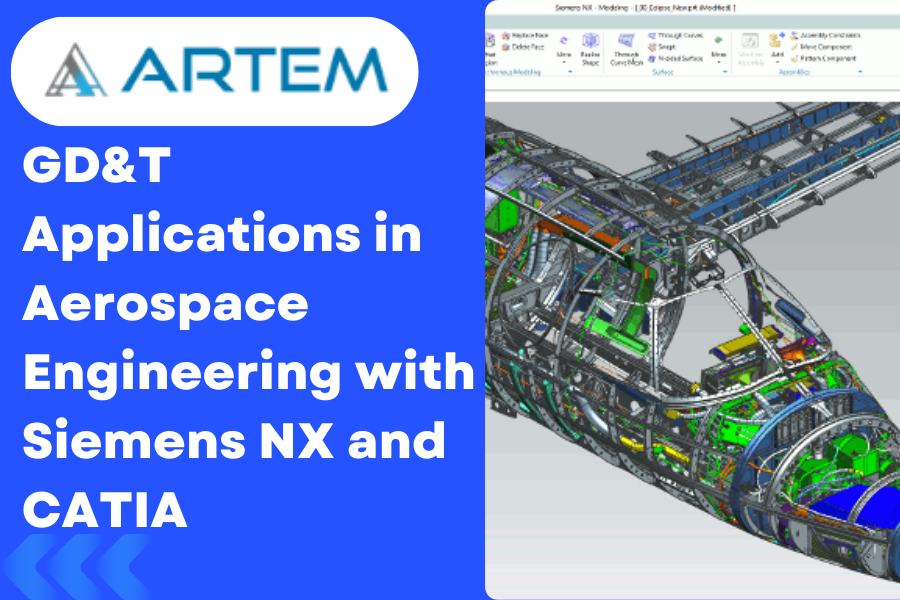
Aerospace engineering stands as a testament to human innovation, pushing the boundaries of what’s possible. At the heart of this cutting-edge industry lies Geometric Dimensioning and Tolerancing (GD&T), a language of precision that ensures every component, no matter how intricate, aligns seamlessly. In this exploration, we’ll delve into real-world case studies, demonstrating how GD&T is intricately woven into aerospace design using CAD tools like Siemens NX and Dassault Systèm CATIA. Case Study 1: Fuselage Alignment in Siemens NX In the design of an aircraft fuselage using Siemens NX, precise alignment is critical for aerodynamics and structural integrity. GD&T plays a pivotal role in ensuring that the various components come together seamlessly. The position control feature in GD&T is employed to define the exact location of critical points on the fuselage concerning a datum reference frame. Example: The GD&T callouts on the blueprint define the position of crucial points, such as mounting brackets and access panels, relative to a specific datum. This precision is vital to maintain the aerodynamic profile and structural stability of the aircraft. Case Study 2: CATIA’s Role in Wing Manufacturing Dassault Systèm CATIA takes center stage in the manufacturing of aircraft wings, where tolerances are incredibly tight. In this scenario, GD&T is used to define not only the dimensions but also the permissible variations in shape, ensuring the wings meet strict performance criteria. Example: The profile of the wing’s airfoil is defined using GD&T in CATIA, ensuring that the curvature and cross-sectional shape conform to the design intent. This meticulous control over the form guarantees optimal lift and drag characteristics during flight. Case Study 3: Aerospace propulsion systems demand unparalleled precision. In the design of engine mounts using Siemens NX, GD&T is employed to guarantee the accurate positioning and alignment of the engine components. Example: GD&T controls are utilized to specify the tolerances for the location of engine mounting points, ensuring that the powerplant aligns precisely with the aircraft’s center of gravity. This level of precision is essential for balanced flight and optimal fuel efficiency. Lessons Learned: The Power of GD&T in Aerospace Design 1. Enhanced Communication: GD&T serves as a universal language, facilitating clear communication between design engineers, manufacturers, and quality control teams. In the aerospace industry, where collaboration is key, this is paramount. 2. Optimized Manufacturing Processes: By defining tolerances and geometric characteristics precisely, GD&T allows for efficient and cost-effective manufacturing processes. This is particularly crucial in aerospace, where components need to meet stringent standards while maintaining a balance between performance and weight. 3. Improved Product Quality: The application of GD&T in aerospace design ensures that every component aligns with design intent, leading to enhanced product quality, increased safety margins, and improved overall performance. In conclusion, GD&T isn’t just a set of symbols on blueprints; it’s the silent force guiding the precision in aerospace engineering. Whether it’s the alignment of fuselage components, the shape of wing profiles, or the positioning of engine mounts, GD&T in conjunction with CAD tools like NX and CATIA is the unsung hero of aerospace design, propelling us to new heights of innovation and reliability.